Thursday, August 1, 2019

The Valley of the Kings

The Valley of the Kings

Located in the West Bank of Luxor, ancient Thebes during the Pharaonic times, the Valley of the Kings is perhaps the most impressive necropolis of ancient Egypt.
Many travel packages to Egypt include a visit to the Valley of the Kings.
Since ancient times, the Pharaohs believed that they were to resurrect after their death. This was a big part of their religious belief.
They used to mummify their deceased and bury them in impressive tombs. They also used to have all their important belongings enclosed with them in order to use them in the afterlife.
At the beginning of the 11th century BC, the kings of the New Kingdom of ancient Egypt.
starting by the Pharaohs of the 18th dynasty began digging their tombs deep inside the mountains of the valley that was later called the Valley of the Kings.

The Tombs

The Valley of the Kings now includes more than 60 tombs. However, almost half of this number is usually closed due to the extensive restoration of the tombs.
Moreover, excavation missions are still going on in the Valley of the Kings and new discoveries are announced every year.
Historians assert that the kings of the New Kingdom of ancient Egypt carried out extensive researches to choose the best location for their new necropolis.
Nevertheless, they chose the exact location for various reasons.
The first reason is that the natural attributes of the Theban mountain enabled them to brilliantly hide their tombs in unexpected places in order to protect them against robberies.
However, this scheme of the ancient Egyptian largely failed as almost all the tombs were robbed in various periods of Egyptian history.

Tutankhamon

The only exception is the tomb of Tut Ankh Amun, the famous young Pharaonic king whose tomb was discovered intact in 1922 by Howard Carter as the most important archeological finding of the 20thcentury.
The main other reason behind the choice of the location of the Valley of the Kings was due to the pyramid-shaped top of the main mountain located there.
The Pharaohs used to believe that the pyramid shape is of significant importance.
They believed it is the beginning of life and the end of their afterlife.
François Champollion, the famous French scientist who was able to discover the meaning of the hieroglyphics language, named this ancient royal necropolis the Valley of the Kings when he visited the site in 1821.
However, the one to be credited with much of the studies of the Valley of the Kings was the British archeologist, John Wilkinson, when he surveyed all the tombs and numbered them as “KV” Kings Valley in 1827.
The most significant feature of the Valley of the Kings and all the other ancient Egyptian tombs is the marvelous colorful wall paintings that represent many aspects of the Pharaonic methodology of the afterlife.
Many tombs at the Valley of the Kings contain many wonderful paintings mainly protracting the owner of the tomb representing the offerings to god and in many other daily life scenes as well.
Perhaps the most interesting tomb of the Valley of the Kings is that of Tut Ankh Amun.
Although it is the smallest tomb at the valley, the wall paintings and the story of its discovery make it one of the most remarkable tombs in the Valley of the Kings admired by all travelers who enjoy their vacation in Egypt and spend a couple of days in Luxor.
Other interesting tombs recommended to be explored by travelers who tour Egypt is that of Ramses VI with its impressive walls paintings, Ramses I with its distinctive blue paintings, Ramses VI with its complex decorations and ornaments, and the tomb of Tuthmosis III.

Sunday, February 3, 2019

Egypt  the land of magic and mystery I like my lovely Egypt if you visit one time you Will not forget  all life we have everything in Egypt so nice come to visit Egypt

Tuesday, June 5, 2018

Saqqara necropolis for the Ancient Memphis- Egyptravel4you-Info

Saqqara necropolis for the Ancient Memphis- Egyptravel4you-Info

Saqqara necropolis for the Ancient Memphis

Saqqara is among the richest and significantly important ancient archeological sites all over Egypt, it was necropolis for the Ancient Memphis.
This was the royal burial site of ancient Egypt beginning of the ruling period of the 3rd dynasty who ruled over the land of the Nile from the around the end of the 29th century to the end of the 27th century.
Situated around 30 kilometers to the South West of Cairo. Saqqara is a wonderful destination for the day and half-day tours from the Egyptian capital.
Tourists who enjoy their vacations in Egypt usually visit Saqqara together with Memphis, the first capital of unified Egypt, and sometimes they go to explore the pyramids of Dahshur.

The Step Pyramid of Djoser

The Step Pyramid of Djoser is the most interesting monument in Saqqara. It is also the heart of the necropolis and one of the most ancient and surviving stone buildings all over the world.
Djoser is credited for constructing the first proper pyramid in the history of ancient Egypt.
The pyramid was constructed during the 27th century, during the reign of King, Djoser.
who ruled over Egypt from 2665 till 2645 BC. He was the second Pharaoh of the 3rd dynasty at the time.
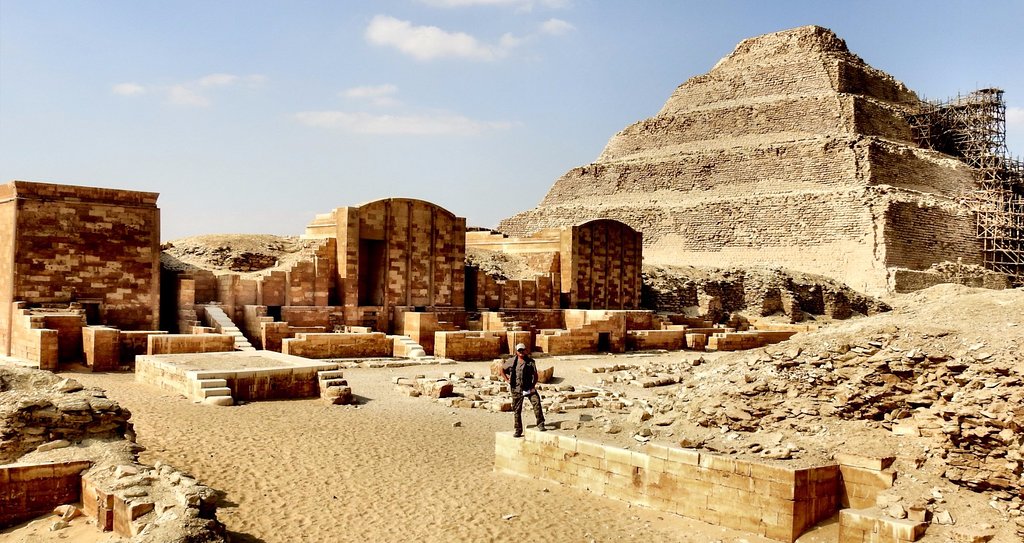
Saqqara the Necropolis for the Ancient Memphis
the step pyramid

Amenhotep

Djoser ordered one of the most brilliant architects of ancient Egypt; Amenhotep to initiate the construction works of his pyramid.
Since Amenhotep was a distinctive architect, he thought of a creative idea to construct the period, which marks an important landmark in pyramids’ building of ancient Egypt.
Before the step pyramid, the Pharaohs only built what they used to call Masataba tombs. Which consisted only of one layer of stones built together.
What Amenhotep did was to build six layers of stones, one above the other, and afterward filled the gaps in each layer. The result was one of the most magnificent achievements of ancient Egypt.
Today, the Step Pyramid of Djoser consists of six layers of stones. It is around 60 meters in height with the base with the measurements of 109 X 125 meters.
Historians assert that the whole building used to be covered with white limestone. However, since it was constructed more than 4500 years ago all this layer disappeared.
Among the remarkable sections of Saqqara, tourists who spend their holidays in Egypt should always visit is the funerary temple of the Step Pyramid.
It was built mainly out of limestone and today it consists of a number of tall pillars with each of them around 14 meters in height.
Of course, the Step Pyramid of Djoser and its other items are the most notable in the whole necropolis of Saqqara. However, there are also some other quite impressive monuments.

Tomb of Mereruka

Other interesting places to explore in Saqqara include, for example, the Tomb of Mereruka. He was one of the high officials during the ruling period of King Teti I.
His tomb is famous for its marvelous wall paintings, especially that of the seasons of the year.

Serapuem

There is also what is called Serapuem. This large underground necropolis belonged to Abis god.

Pyramid of Unas

There is the Pyramid of Unas as well.
Constructed in the 23rd century BC, the pyramid belongs to the last king of the 5th dynasty of ancient Egypt.

Museum of Imhotep

Newly established, there is the Museum of Imhotep. Established in 2006, this museum is dedicated to the famous genus architect of ancient Egypt.

Thursday, October 20, 2016

Welcome to my lovely Egypt if you come to visit you will not forget ever wthe my best wishes